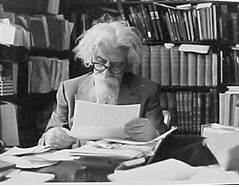
The Greeks learned in order to comprehend. The Hebrews learned in order to revere. The modern man learns in order to use...Knowledge means success. We do not know any more how to justify any value except in terms of expediency...
We teach our children how to measure, how to weigh. We fail to teach them how to revere, how to see wonder and awe. The sense of the sublime, the sign of the inward greatness of the human soul and something which is potentially given to all men, is now a rare gift...
Awe enables us to perceive in the world intimations of the divine, to sense in small things the beginning of significance, to sense the ultimate in the common and the simple; to feel in the rush of the passing the stillness of the eternal.
~Rabbi Abraham Joshua Heschel
This is a tough place to live. There may be no lack of physical resources here, but there is a gaping hole in one of the fundamental necessities of being human. America seems to have lost sight of what it is that truly has value. But not only that—this is only a symptom of a larger problem. We do not know how to go about finding value; we are not even sure such a pursuit could ever take us anywhere. It is the underlying naturalistic philosophy that has depleted our resources for accurately and confidently judging what can be considered valuable. Indeed, on some level, every American has been influenced to think that in order to hold any beliefs about what has worth in their life they must also hold some empirical justification. This assumption about empirical justification has caused us to rely on defining the value of life in purely utilitarian terms. That is, we have come to view a truly good life as one that consists of mostly pleasure and as little pain as possible.
Not too long ago I took part in a discussion about euthanasia. In this discussion I quickly realized that it was nearly unanimous among the participants that a life was no longer worth living if there was no more pleasure, or at least very little pleasure to be experienced. At first glance, this seems like it makes sense; our Western upbringing confirms this view and we are inclined to agree. But can we really accept that the only thing that should compel us to live our lives is the pleasure we experience; should we really buy into this shallow and consumer-friendly philosophy? Perhaps. But I believe that this yeilds an incomplete explanation of the human experience. I am not ready to ignore the wisdom of so many humans in history that have found a higher purpose for life. I am not ready to abandon the eternal because it does not fit into naturalism's tiny box. Rabbi Heschel was so kind to remind us that we should break free from this philosophical restraint—this false foundation that suppresses the awe we ought to have for the world outside us and the spirit within us. If we are to have any success in giving a more complete assessment, we must move beyond the demand for empirical justification and onto the human—even divine—affirmations of what makes life worth living. What are these affirmations? They need not seem so strange to us.
Consider the grand view of the Pacific Northwest that floods your senses as you sit, perched in the rocky heights of the mountains. Consider that feeling; how you shrink into the landscape; how the thin air and big sky makes you suddenly aware of your breathing and sends a jolt of adrenaline through the body. Now you consciously take in the oxygen, all the while made to feel small, short-breathed and short-lived. In comparison to the enormous and enduring Mount Hood you are only a fraction. Here, on this mountain, you begin to make sense of sunsets and the eyes with which you see them; in these kinds of moments—when you know you have a heart and lungs because you feel them working for your existence—you begin to wrestle with the reasons for even getting down off this mountain.
Think of the conclusions you make during the late-night episodes of Seinfeld with your girlfriend; when you happen to look over as she sits on the sofa beside you, her eyes fastened to the screen; you look as the television casts a flickering blue hue over the whole room and the sight of her dimly lit face sends a mysterious warmth into your gut. She laughs at the loopy comedy and leans into your chest—her sweet scented conditioner makes your lips smile but your head swim. You begin to question: Is it worth it—becoming so attached to this person, this temporal thing that must eventually whither away? Must this dread of pain be a part of a life well-lived? Could I live without her? But could I really be a family man? Her gentle hand, as it reaches and embraces yours, brings you back to the blue-washed room of sitcoms and simple answers; your conclusion becomes so clear and you softly tell her you love her.
Finally, think of the compelling rhetoric of the black day when you bury your loved one. When the repetitious offering of empty condolences turns your face to the clouds; you search for some higher sympathy in the silent sky. You are embittered by the betrayal; life leads you on to believe in love only to lose it and here you are, left as the laughing-stock. Like Mike Corleone, when betrayed by his brother, you wrap your hands around God’s skull, his hair between your fingers, and you force his forehead to your lips for the kiss. "You broke my heart" are the only words you find when looking into the eyes of God. You leave the funeral and find yourself in the stiff and now lonely bed, finally tucked away in the house that has lost its home. You lie there with grinding teeth, daring God to prove his mercy. But somewhere, in the course of the night or in the course of life, you begin to understand hope. You understand because you have seen despair, and through it, you have seen the face of God.
You see, at some point, our symbol for wisdom has been altered; we have exchanged the gray crown worn by our elders for the white lab coat worn by vibrant scholars. The aged and tattered are marginalized while the heathy and inexperienced are exalted. This shift is a sign. Truth has been entrusted to the weak, wobbly legs of science.
Can these human experiences justify our judgments about the value of life, love, and the eternal? Or should we forfeit them to a philosophy that defines them as mere physiological fuzzies?
4 comments:
Adam! You are quite the writer!
it makes me happy that you are on here too. AND that you will be doing it more frequently. i just started, but i think it will be a great way to keep updated with everyone. it also makes me happy that you and sara are in town today! you should probably come up again next weekend for graduation.
Adam, this post is so great. Thanks!! I hope we can hang out soon. :)
umm...this is Lauren Benson, by the way. :)
Post a Comment